
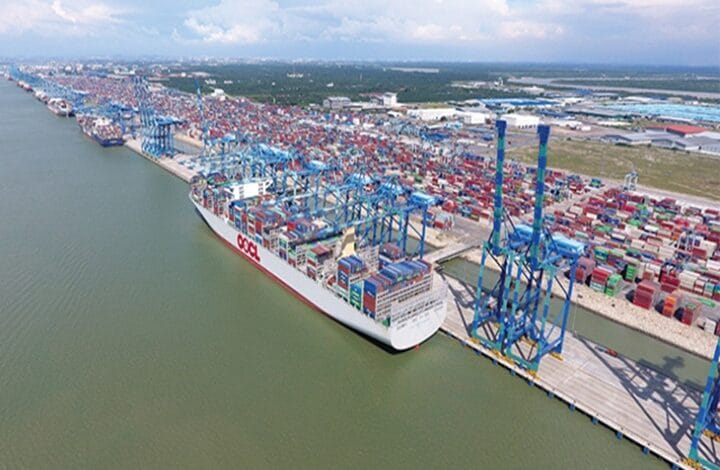
Port Klang Records 5.2% Growth in First Quarter Despite Global Trade Uncertainty

KLANG: Port Klang continued to demonstrate strong resilience in the face of global uncertainty after recording a 5.2 per cent growth in the first quarter of 2026, despite concerns over geopolitical tensions and disruptions to international trade routes.
The encouraging performance underscores Malaysia’s growing strength in trade and logistics while reinforcing Port Klang’s position as one of the region’s leading maritime and transshipment hubs.
Transport Minister Anthony Loke Siew Fook said the country’s main gateway handled a total of 3.71 million twenty-foot equivalent units (TEUs) during the first three months of the year through its two major terminals, Westports Malaysia and Northport Malaysia.
The figure represents an increase from 3.53 million TEUs recorded in the corresponding period last year.
According to Anthony, the performance exceeded expectations as global markets were already beginning to feel the effects of tensions in the Middle East, particularly concerns surrounding the Strait of Hormuz, one of the world’s most important shipping routes.
“The first quarter was exceptionally strong with growth of 5.2 per cent. Frankly, I believe this performance surpassed expectations considering the uncertainties caused by the conflict involving Iran.
“Despite the challenges, Port Klang managed to weather the situation and deliver positive results,” he told reporters after the pre-launch of the Port Klang Free Zone (PKFZ) Smart Intelligence Industrial Park here today.
Anthony said he remains optimistic about the outlook for the second quarter, especially following positive developments regarding peace efforts between the United States and Iran.
He said greater geopolitical stability could help boost global trade flows and stimulate Malaysia’s export and import activities.
“I believe our trade and export volumes will continue to improve. If geopolitical conditions become more stable and international shipping routes remain open, it will certainly benefit our ports and trading activities,” he said.
Data released by the Port Klang Authority (PKA) showed that export transshipment volumes rose 5.5 per cent to 832,231 TEUs compared with 788,997 TEUs during the same period last year.
Import volumes also recorded growth, increasing by 5.2 per cent to 850,628 TEUs from 808,754 TEUs previously.
The positive figures indicate sustained momentum in Malaysia’s manufacturing, export and logistics sectors, supported by growing international demand and efficient port operations.
Overall, Port Klang handled 15.3 million TEUs throughout 2025, maintaining its status as one of the busiest container ports globally.
Meanwhile, Anthony said the Port Klang Free Zone (PKFZ) is targeting revenue of RM114 million this year after achieving a record-high RM108 million in 2025.
He noted that the free zone continues to attract strong interest from investors due to its strategic location and comprehensive infrastructure.
“There is still tremendous growth potential. Investors view PKFZ not only as an industrial area but also as a major warehousing and logistics hub.
“A significant amount of London Metal Exchange (LME) metals is also stored here,” he said.
Anthony added that PKFZ is aiming for an investment composition of 80 per cent local companies and 20 per cent foreign investors.
He said the development of the Smart Intelligence Industrial Park is expected to attract more high-technology investments while further strengthening Port Klang’s role as a smart trade and logistics hub that supports Malaysia’s long-term economic growth.