Sanusi Says Jempol Speech Was About Malay Historical Identity, Not Non-Malay Citizenship

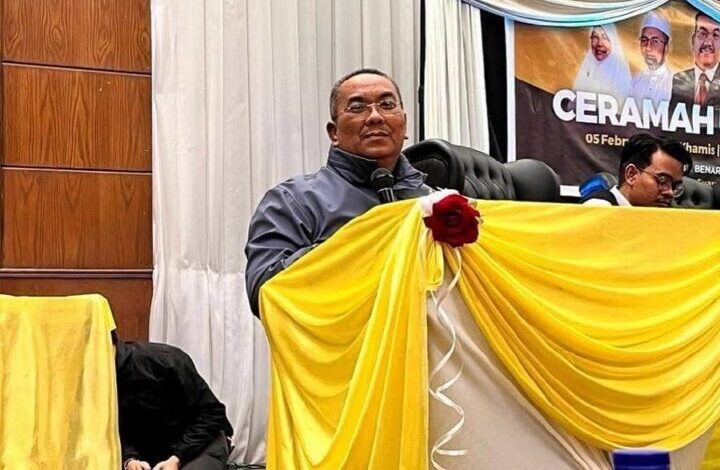
PETALING JAYA: Kedah Menteri Besar Datuk Seri Muhammad Sanusi Md. Nor has clarified that remarks made during a political speech in Jempol last week were intended to discuss the historical relationship between the Malay community and Tanah Melayu, and were not meant to question the citizenship or constitutional rights of Malaysians of Chinese and Indian descent.
In a statement issued on Monday, Sanusi said his speech on July 23 focused on the historical origins of Tanah Melayu as the ancestral homeland of the Malay community, as well as his concerns over the current political and economic position of Malays in the country.
He said references to Tanah Melayu were grounded in historical records rather than contemporary political rhetoric, citing parliamentary records from Britain dating back to 1946, 1949 and 1957 that, according to him, recognised Tanah Melayu as the historical homeland of the Malays.
Sanusi maintained that these historical references predated Malaysia’s independence and were part of documented constitutional and political discussions rather than ideas introduced in recent years.
The clarification follows public criticism of an earlier speech in which Sanusi said Malays only have Tanah Melayu as their homeland, whereas other ethnic communities have countries historically associated with their ancestral origins.
Those remarks sparked debate after some commentators interpreted them as questioning the place or citizenship of non-Malay communities in Malaysia.
Responding to those criticisms, Sanusi rejected that interpretation, saying his speech should not be read in isolation.
He stressed that recognising Tanah Melayu as the historical homeland of the Malays does not mean that Malaysians from other ethnic backgrounds have no rights in the country.
Sanusi also denied that he had called for Malaysians of Chinese or Indian descent to leave Malaysia.
Instead, he said another portion of the same speech emphasised the importance of peaceful coexistence among Malaysia’s diverse communities.
As an example, he referred to remarks in which he said Chinese traders are able to operate businesses in Malay-majority villages without interference, adding that he had stated, “We do not disturb others,” to illustrate his point about harmonious inter-ethnic relations.
According to Sanusi, the broader message of his speech centred on concerns regarding the political representation and economic wellbeing of the Malay community rather than advocating exclusion of any ethnic group.
He further argued that his views are consistent with historical observations made by several British figures, including Oliver Stanley, Lord Killearn and Lord Ogmore, who discussed the historical, political and cultural relationship between the Malays and Tanah Melayu during the colonial period.
Sanusi said these historical references highlighted the longstanding association between the Malay community and institutions such as the Malay states, the Malay language, Malay customs, Islam, the Malay Rulers and the former Federation of Malaya.
He maintained that his remarks represented a contemporary political expression of historical narratives that had previously been recorded in British parliamentary proceedings rather than a new or unprecedented political position.