Malaysia’s economy projected to expand 5.6% in second quarter as domestic demand remains resilient

KUALA LUMPUR: Malaysia’s economy is expected to record stronger growth in the second quarter of 2026, with gross domestic product (GDP) projected to expand 5.6 per cent year-on-year, up from 5.4 per cent in the first quarter, supported by resilient domestic demand, sustained private consumption and steady investment activity.
The latest outlook reflects continued strength in the country’s economic fundamentals despite an increasingly uncertain global environment marked by geopolitical tensions, trade disruptions and moderating international growth.
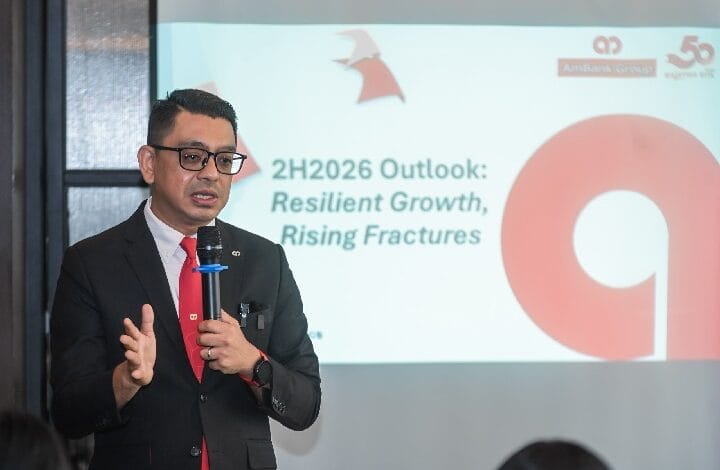
AmBank Group Chief Economist Firdaos Rosli said stronger tourism activity during the April-to-June period was among the key contributors to higher household spending, helping sustain private consumption despite growing external headwinds.
He noted that robust domestic demand remained the principal engine of economic expansion, complemented by consistent investment from both the private and public sectors.
“Private consumption continues to be supported by several encouraging indicators. Wholesale and retail trade maintained healthy momentum after recording solid growth earlier this year, while resilient vehicle sales also point to continued consumer confidence and the underlying strength of Malaysia’s domestic economy,” he said during AmBank’s Second Half 2026 Macroeconomic Outlook media briefing.
Looking ahead, Firdaos said AmBank has revised its full-year 2026 GDP growth forecast upward to 4.8 per cent, compared with its previous projection of 4.5 per cent.
The revised forecast places growth near the upper end of Bank Negara Malaysia’s (BNM) official projection range of 4.0 to 5.0 per cent, reflecting expectations of continued support from domestic policy measures and global technology investments.
He said household consumption is expected to benefit from ongoing fiscal initiatives, while infrastructure development programmes and sustained private sector investments will continue supporting economic activity throughout the year.
At the same time, Malaysia is expected to benefit from the accelerating global artificial intelligence (AI) investment cycle, which continues to boost demand for the country’s electrical and electronics (E&E) exports as well as investments related to information technology and digital infrastructure.
Despite the improved outlook, Firdaos cautioned that economic growth this year is still likely to moderate compared with the 5.2 per cent expansion recorded in 2025.
He said economic activity is expected to soften during the second half of the year as higher global commodity prices gradually filter through the international economy, increasing production costs and weighing on business activity.
External risks also remain tilted to the downside despite the recent peace agreement between the United States and Iran, with uncertainty surrounding global trade, supply chains and geopolitical developments continuing to pose challenges.
According to Firdaos, growth is also expected to vary significantly across industries.
Technology-related sectors are likely to remain among the strongest performers as global AI adoption continues driving investment and demand across semiconductor and electronics supply chains.
Conversely, industries facing rising input costs and supply chain disruptions linked to ongoing tensions in West Asia could continue experiencing pressure on profit margins.
Firdaos also highlighted signs of moderation in household spending during the early part of the year.
Private consumption growth eased to 4.7 per cent in the first quarter of 2026 from 5.6 per cent recorded in the final quarter of 2025, despite support from several government initiatives, including higher civil servant salaries introduced in January, the one-off RM100 cash assistance provided to all adult Malaysians in February, as well as festive spending during the Chinese New Year and Hari Raya Aidilfitri celebrations.
He said the moderation corresponds with slower household credit growth, suggesting consumers are becoming increasingly cautious in managing discretionary spending amid a more uncertain economic outlook.
Moving forward, private consumption is expected to remain positive but moderate, as consumers continue adjusting to rising living costs, heightened global uncertainty and a slight increase in unemployment, factors that could gradually weigh on purchasing power and overall consumer sentiment during the remainder of 2026.