
NAVEE Commercial Strengthens Urban Mobility Vision With New Fleet and Energy Solutions

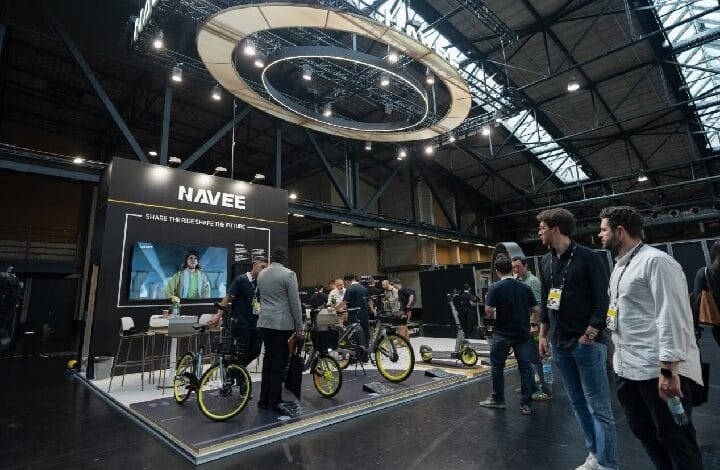
BERLIN, June 3 — Urban mobility technology provider NAVEE Commercial has expanded its smart transportation portfolio with the introduction of several new products at Micromobility Europe 2026, underscoring its ambition to build a more comprehensive urban mobility ecosystem.
The company’s latest showcase reflects a strategy that extends beyond shared transportation to include delivery solutions, urban energy services and accessibility-focused mobility products.
At the centre of the exhibition was the launch of the N2 shared e-bike, a new model developed to help fleet operators improve operational efficiency while reducing long-term ownership costs.
NAVEE Commercial said the N2 is built on a 24-inch platform that combines rider comfort with stability and manoeuvrability, making it suitable for high-density urban environments.
The vehicle’s lightweight design also helps simplify fleet deployment and day-to-day management for operators.
European Market Director Kaiyu Gu explained that the company focused heavily on the practical challenges faced by mobility providers, including maintenance requirements, parking compliance, operational efficiency and fleet utilisation.
According to him, successful shared mobility solutions must address both rider expectations and operator profitability.
The N2 has also been designed to support sustainability initiatives adopted by many European cities while maintaining compatibility with NAVEE Commercial’s broader battery ecosystem.
This compatibility enables operators to streamline charging operations and reduce maintenance complexity across multiple vehicle types.
The company estimates that the model may achieve a return on investment within approximately 120 days depending on deployment conditions.
Expanding Into Urban Energy Infrastructure
Beyond mobility services, NAVEE Commercial also introduced the PB1 shared power bank system, which supports fast charging at up to 22.5W.
The system is intended for installation in shopping centres, cafés, transportation hubs and other public venues where demand for mobile device charging continues to increase.
The move marks the company’s expansion into urban energy infrastructure, complementing its existing transportation-focused offerings.
The exhibition also featured NAVEE Commercial’s broader vehicle lineup, including the V2 Pro and V2 Lite shared e-scooters, M2 shared e-bike, XM1 and X1 delivery vehicles, B1 bicycle and the LM1 mobility vehicle.
The V2 Pro remains one of the company’s flagship products, offering a travel range of up to 110 kilometres while utilising a modular structure that simplifies repairs and lowers maintenance costs.
Meanwhile, the LM1 has been developed to provide elderly users and individuals with disabilities a safer and more accessible mobility option.
Digital Tools Drive Operational Efficiency
To support operators beyond vehicle deployment, NAVEE Commercial unveiled the City King platform, a cloud-based system that integrates fleet monitoring, vehicle management and operational analytics.
The platform allows operators to track vehicle performance in real time, coordinate maintenance schedules and optimise resource allocation through data-driven decision-making.
Global Sharing Business Leader Olivia Zhan said the mobility sector is increasingly shifting toward long-term operational sustainability rather than focusing solely on vehicle specifications.
She noted that operators are looking for integrated ecosystems that combine transportation, logistics, energy services and intelligent fleet management under a single framework.
By expanding its portfolio across multiple urban mobility segments, NAVEE Commercial aims to strengthen its global presence while helping cities and operators build smarter, more connected and environmentally sustainable transportation networks.