
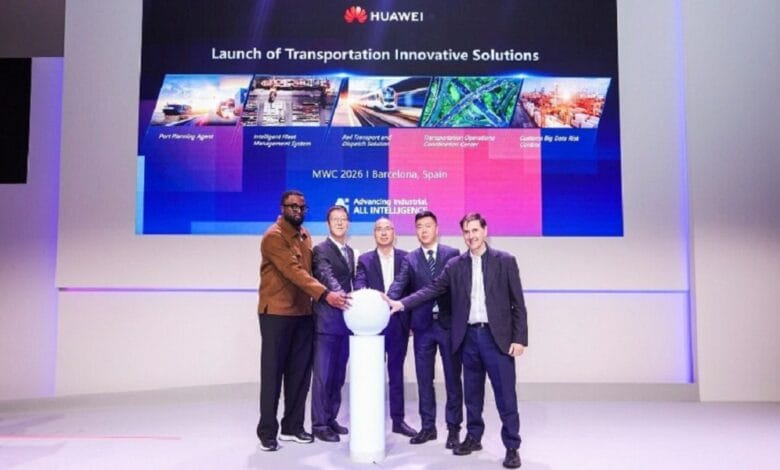
Huawei Introduces Five Next-Generation Solutions to Drive Global Smart Transportation Revolution

BARCELONA — Technology leader Huawei has unveiled an ambitious vision to transform the global transportation sector through advanced digital technologies, announcing five new intelligent solutions aimed at reshaping mobility and logistics worldwide.
The announcement was made during the Accelerate Transportation Digital Intelligence forum held at Mobile World Congress (MWC) Barcelona 2026. The event brought together global industry partners, transportation authorities, technology experts and enterprise customers to discuss how emerging technologies such as artificial intelligence and advanced connectivity are redefining the future of transportation infrastructure.
Huawei said the new solutions are designed to push the transportation industry toward a fully intelligent ecosystem where passenger movement, freight logistics, information systems and operational processes are seamlessly integrated through digital technologies.
Building the Digital Backbone of Future Transportation
David Shi, Vice President of ICT Marketing and Solution Sales at Huawei, emphasised that collaboration between technology providers, industry partners and governments will be essential to building a more connected and efficient transportation ecosystem.
He explained that Huawei’s strategy focuses on building a robust digital infrastructure capable of supporting various transportation sectors including road networks, rail systems, aviation, logistics and port operations.
By combining artificial intelligence with high-performance connectivity platforms, Huawei aims to improve safety standards, streamline operations and reduce inefficiencies across global transport networks.
“Huawei remains committed to open collaboration and shared development. Together with our partners and customers, we are building a digital and intelligent foundation that connects passengers, freight services, businesses and information flows,” Shi said during the forum.
Artificial Intelligence Emerging as Transportation Control Center
Industry experts attending the forum agreed that artificial intelligence is quickly becoming the central nervous system of modern transportation networks.
Carlos López Gutiérrez, Transportation Business Unit Director at SICE, said AI and edge computing technologies are already playing a crucial role in strengthening transportation infrastructure and improving operational reliability.
SICE has partnered with Huawei to develop intelligent platforms capable of analysing real-time data from multiple transportation systems, enabling smarter decision-making and improved traffic coordination.
According to López Gutiérrez, these technologies will allow cities and transport authorities to better manage traffic flows, reduce congestion and enhance overall infrastructure connectivity.
Smart Airports and Rail Systems Accelerating Digital Transformation
PhD Reha Çetin, Chief Information Officer of Istanbul Grand Airport and CEO of IST Systems, shared insights into the airport’s digital transformation strategy.
He said Istanbul Airport is implementing an Airport 5.0 initiative that leverages Huawei’s advanced ICT capabilities to deliver next-generation passenger experiences while improving operational efficiency.
As one of Europe’s fastest-growing aviation hubs, the airport aims to integrate digital technologies across passenger services, security systems and operational management.
Meanwhile, Zaiming Ren, Deputy General Manager of CRSC International, highlighted the role of next-generation communication systems in improving railway efficiency.
The Future Railway Mobile Communication System (FRMCS) is designed to enhance train control operations while boosting network capacity and reducing lifecycle costs.
Ren said the technology will enable rail operators to maintain safer and more efficient services as railway networks continue expanding globally.
Smart Ports Driving Global Trade Efficiency
Ports remain critical gateways in global supply chains, and Huawei believes digitalisation will play a crucial role in modernising port operations.
Yang Rong, Chief Engineer at Tianjin Port Group, explained that the port has already integrated technologies such as 5G networks, artificial intelligence, cloud computing and autonomous driving into its operations.
Through these technologies, the port has developed intelligent systems that allow digital management of port infrastructure while improving cargo handling efficiency.
These innovations are helping ports handle increasing global trade volumes while maintaining operational stability and supply chain reliability.
Five New Solutions Transform Key Transportation Scenarios
Huawei’s newly announced solutions target several core areas within the transportation ecosystem.
One of the solutions focuses on road transportation management through the Transportation Operations Coordination Center (TOCC). The platform enables integrated traffic monitoring and supports transportation planning during peak travel periods such as major holidays.
In the railway sector, Huawei has introduced a next-generation bearer network designed to support railway dispatching and operational communications with ultra-low latency and high reliability.
Another solution targets customs authorities by deploying a big-data-based risk control system capable of analysing multiple data sources simultaneously. The system can detect potential risks within seconds, helping improve customs supervision and border clearance efficiency.
Huawei also introduced an intelligent scheduling system for ports powered by chain-of-thought artificial intelligence technology. The system coordinates key port activities including berth allocation, cargo distribution and vehicle scheduling.
By automating complex planning processes, the technology can reduce operational planning times from hours to just minutes.
Additionally, Huawei unveiled an upgraded intelligent horizontal transportation system designed to manage large fleets of vehicles operating inside ports.
The system supports mixed operations involving traditional container trucks and intelligent guided vehicles while maintaining extremely precise positioning accuracy.
Breakthrough in Railway Connectivity
During the forum, Huawei also announced the commercial deployment of the world’s first 1.4 GHz 5G fixed wireless access network specifically designed for railway applications.
Developed in partnership with telecommunications provider Surge, the network has been successfully implemented along Indonesia’s railway lines.
The deployment marks a major milestone in railway communication infrastructure, providing high-speed connectivity that supports digital railway operations while expanding nationwide network coverage.
Global Expansion of Smart Transportation Technologies
Huawei also showcased the Global Smart Port Showcase developed in partnership with Shandong Port Group.
The initiative demonstrates how advanced technologies such as big data analytics and large-scale AI models can be used to improve operational planning and digital port management.
According to Huawei, its smart transportation solutions have already been deployed in numerous large-scale projects worldwide.
The company has supported more than 100 ports, over 210 airports and airlines, and more than 300 urban railway systems globally.
Huawei technologies are also used in railway networks spanning over 180,000 kilometres and road infrastructure covering more than 200,000 kilometres across various countries.
Looking ahead, Huawei said it will continue expanding its “platform plus ecosystem” strategy, working closely with partners to build a fully integrated digital transportation infrastructure.
The company believes that combining advanced connectivity, artificial intelligence and data-driven platforms will ultimately usher in a new era of intelligent mobility and logistics worldwide.
-wilayah.com.my