
Hanyang University Unveils AI-Designed Shape-Shifting Microneedle Patch to Speed Up Diabetic Wound Healing

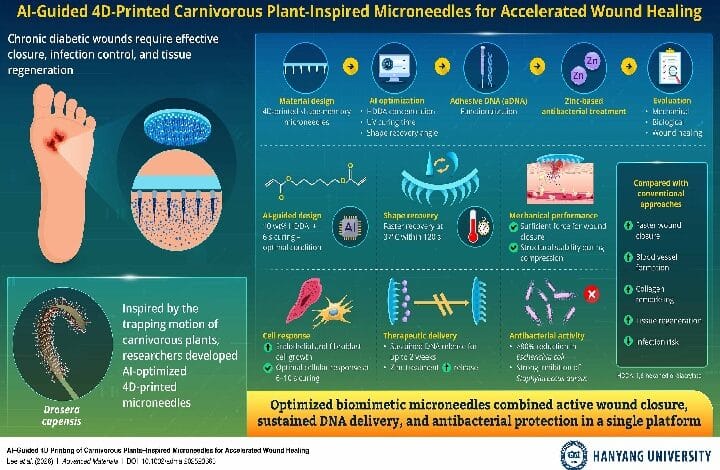
SEOUL: Researchers at Hanyang University in South Korea have developed an artificial intelligence-powered medical device capable of transforming the treatment of chronic diabetic wounds by combining AI, 4D printing, biomimicry and regenerative medicine into a single smart wound-healing platform.
The newly developed technology features a shape-changing microneedle patch designed to actively close wounds, suppress bacterial infections and stimulate tissue regeneration, addressing several limitations associated with conventional wound-care methods.
The research, led by Associate Professor Hyun-Do Jung, was published in the scientific journal Advanced Materials after first becoming available online on March 30.
Chronic wounds remain one of the most common complications affecting people with diabetes, often resulting in prolonged healing, persistent inflammation and an increased risk of infection. Existing treatments, including sutures, staples and medical adhesives, generally provide mechanical closure but lack the ability to respond dynamically to the body’s natural healing process.
Seeking a more adaptive solution, the research team turned to nature for inspiration.
The device was modelled after Drosera capensis, a carnivorous plant known for its coordinated movement, adhesive properties and protective mechanisms used to capture prey.
Using those biological principles, the researchers designed a microneedle system capable of automatically changing shape once exposed to normal body temperature of approximately 37 degrees Celsius.
Manufactured through advanced 4D-printing technology, the microneedles gradually bend after insertion into tissue, allowing them to pull wound edges closer together while maintaining stable contact throughout the healing process.
Artificial intelligence played a crucial role during development.
Machine-learning algorithms were used to analyse how different material compositions and manufacturing conditions influenced shape recovery and mechanical performance. This significantly reduced the need for time-consuming trial-and-error experimentation.
Among the predictive models tested, Gaussian Process Regression delivered the highest level of accuracy while also providing reliable uncertainty estimation, enabling researchers to identify the optimal manufacturing parameters.
According to Dr. Jung, the project demonstrates how AI can move beyond simple automation by transforming biological inspiration into programmable biomedical technologies suitable for future clinical applications.
Beyond its mechanical capabilities, the microneedle platform integrates several therapeutic functions designed to improve wound recovery.
The device incorporates adhesive DNA nanoparticles that promote tissue regeneration while its zinc-treated surface provides continuous antibacterial protection.
Laboratory evaluations showed sustained DNA release together with favourable cellular responses from fibroblasts and endothelial cells, both of which play essential roles in tissue repair.
The zinc coating also demonstrated strong antibacterial activity against Escherichia coli and Staphylococcus aureus, two bacteria commonly associated with infected chronic wounds.
Preclinical testing further confirmed that the integrated system accelerated wound closure while producing better tissue regeneration compared with conventional treatment approaches.
Researchers believe the AI-guided 4D-printing strategy has applications extending well beyond diabetic wound care.
Potential future uses include smart wound dressings, tissue-engineering scaffolds, biomedical implants, vascular stents and soft medical robots capable of changing shape and maintaining stable interaction with biological tissues.
Although further studies and clinical validation will be required before the technology reaches hospitals, the innovation represents a significant advance in intelligent biomaterials, demonstrating how artificial intelligence can accelerate the development of adaptive medical devices designed to improve patient outcomes and reduce complications in regenerative medicine.