
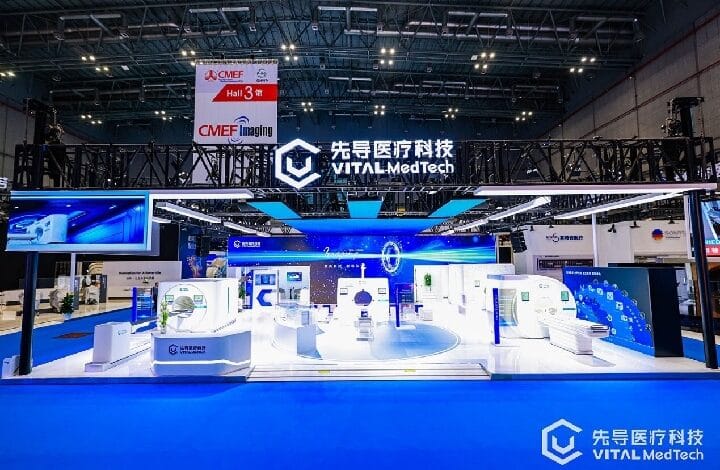
VITAL MedTech Unveils Fully Integrated Imaging Technology to Address Global Supply Bottlenecks at CMEF 2026

SHANGHAI — VITAL MedTech has introduced a vertically integrated technology framework aimed at resolving long-standing supply constraints in medical imaging, presenting its latest innovations at CMEF 2026.
Backed by its parent company VITAL MATERIALS, the firm showcased how control over semiconductor materials, chip design and system-level engineering can unlock new levels of performance in diagnostic imaging.
Industry Bottlenecks Drive Need for Integration
The medical imaging sector has faced persistent challenges due to its reliance on external suppliers for critical components, particularly in high-end systems.
These dependencies often slow down development cycles, increase costs and limit innovation. VITAL MedTech’s approach focuses on overcoming these barriers by integrating every stage of the production chain under a single ecosystem.
Experts say this model could significantly improve efficiency and reduce time required to bring new technologies to market.
Advancing Toward Precision Imaging
The industry is moving beyond basic digital imaging into a new era defined by precision diagnostics, where the ability to detect extremely faint biological signals becomes increasingly important.
This capability depends heavily on detector sensitivity and material performance, areas where semiconductor innovation plays a central role.
VITAL MedTech’s technologies aim to push these boundaries, enabling more accurate imaging and better diagnostic outcomes.
End-to-End Technology Integration
At CMEF 2026, the company demonstrated its full vertical integration, covering semiconductor materials, core components and finished medical systems.
Technologies based on CZT, SiC and InP semiconductors were highlighted as key building blocks of this ecosystem.
By controlling the entire value chain, VITAL MedTech can ensure better compatibility between components, leading to improved performance and system reliability.
Breakthroughs in Detector and MRI Systems
Among the innovations presented was a CZT-based detector capable of capturing individual X-ray photons with higher precision, improving energy resolution compared to traditional technologies.
This advancement allows for clearer imaging and potentially earlier detection of medical conditions.
The company also introduced improvements in MRI technology through the use of silicon carbide (SiC)-based gradient amplifiers, which reduce energy losses and enable faster signal response.
These developments support the creation of next-generation MRI systems that are more energy-efficient and capable of delivering faster scans.
Addressing Data Processing Challenges
Modern imaging systems generate vast amounts of data, often leading to processing delays.
VITAL MedTech tackled this issue using indium phosphide (InP)-based optoelectronic integration, enabling high-speed data transmission and real-time processing of large datasets.
This capability is expected to enhance workflow efficiency in clinical settings, allowing healthcare professionals to make quicker and more informed decisions.
Transforming Technology into Clinical Value
Founder and chairman Zhu Shihui emphasised that the company’s goal extends beyond technological advancement to improving patient care.
“Our focus is to translate innovations in materials science into practical tools that enhance diagnostic precision and clinical outcomes,” he said.
Industry observers noted that the integrated model could shorten the pathway from research to application, making advanced technologies more accessible.
Positioning for Future Healthcare Innovation
VITAL MedTech’s comprehensive approach reflects a broader shift in the medical technology industry towards integration and efficiency.
By combining expertise in materials science, semiconductor engineering and medical systems, the company aims to redefine how imaging technologies are developed and deployed.
As demand for advanced diagnostics continues to rise, such innovations are expected to play a key role in shaping the future of healthcare.
-wilayah.com.my