
Sanusi Rejects DAP Claim, Says PAS Contest Strategy Reflects Voter Demographics

ALOR SETAR, July 3 — PAS Election Director Datuk Seri Muhammad Sanusi Md. Nor has dismissed DAP secretary-general Anthony Loke Siew Fook’s claim that the Islamist party avoids direct contests with DAP, arguing that electoral seat allocations have long been guided by the demographic composition of constituencies rather than political fear.
Sanusi said PAS has never based its election strategy on avoiding particular opponents, but instead contests seats where it believes it has established voter support. He added that the same principle is applied by other political parties, including DAP.
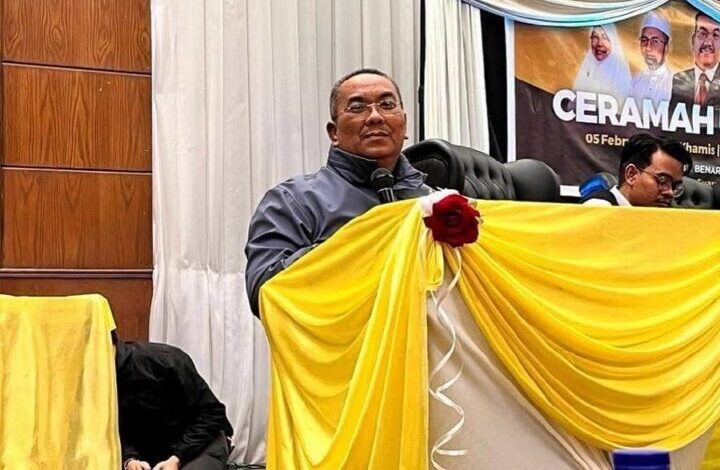
Speaking after opening the Kedah Malay Contractors Association (PKMM) annual general meeting, Sanusi said it would make little political sense for PAS to contest constituencies where Chinese voters form the overwhelming majority.
“If a constituency has a Chinese-majority electorate, why should PAS contest there? We know who supports us and who does not. Likewise, DAP also knows where its support lies. That is simply the reality of Malaysian politics,” he said.
The Kedah Menteri Besar also challenged Anthony Loke to contest the Jeneri state seat in a future election if he wished to demonstrate his political courage.
Sanusi said criticism that PAS avoids Chinese-majority constituencies should equally apply to DAP if its leaders were unwilling to stand in predominantly Malay constituencies.
“If he says PAS is afraid to contest in Chinese-majority areas, then let him contest in Jeneri at the next election. We can then see how the contest unfolds,” he said.
According to Sanusi, the pattern of political competition in Malaysia has developed over many years based largely on demographic realities rather than deliberate electoral tactics.
He said constituencies with predominantly Malay voters are typically contested by parties such as PAS, UMNO and Bersatu, while DAP, MCA and Gerakan have traditionally focused on areas with larger Chinese electorates.
“There is no need to confuse the public. Chinese-majority constituencies are usually contested by parties with support there, while PAS or UMNO generally compete in Malay-majority seats. That has been the political landscape for many years,” he said.
Sanusi also argued that Malaysian political parties have historically grown by drawing support from different ethnic communities, with PAS and UMNO receiving backing primarily from Malay voters, while MCA and Gerakan have traditionally attracted support from Chinese voters.
His remarks came a day after Anthony Loke alleged that PAS was reluctant to face DAP directly in the Johor state election and had instead relied on Barisan Nasional (BN) as a “proxy” in constituencies contested by DAP.
Loke had claimed PAS’ decision not to field candidates in DAP-contested seats formed part of a broader strategy to consolidate votes for BN candidates, particularly those from MCA.
He also criticised PAS as being inconsistent in principle after the party urged its supporters to back BN candidates in seats where Perikatan Nasional (PN) was not contesting.