
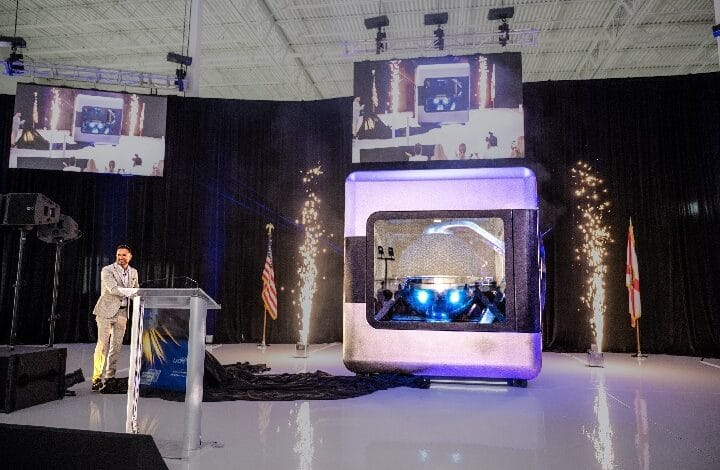
AMPERA Unveils First Full-Scale 3D-Printed Nuclear Reactor Module, Advances Factory-Built Thorium Technology

PALM BEACH GARDENS, Fla., July 3 — Advanced nuclear technology developer AMPERA has unveiled what it describes as the world’s first full-scale, three-dimensional (3D) printed nuclear reactor module, marking a significant step in the company’s efforts to commercialise factory-built thorium-based nuclear energy systems.
The milestone was announced following the completion of the company’s first full-scale reactor module, comprising both the reactor core and pressure vessel, at its innovation centre in Palm Beach Gardens.
More than 100 guests, including local government representatives, business leaders and company employees, attended the unveiling ceremony held on July 1.
AMPERA is developing what it says will be the world’s first factory-built, solid-state, subcritical thorium nuclear reactor, with the latest achievement representing an important stage in the technology’s development programme.
Founder and Chief Executive Officer Brian Matthews said the completed reactor module demonstrates the commercial potential of combining advanced nuclear engineering with additive manufacturing technologies.
According to Matthews, the fully printed reactor core and pressure vessel provide the foundation for future mass production of modular nuclear systems designed for factory assembly rather than conventional on-site construction.
The reactor module incorporates a spherical monolithic gyroid core manufactured entirely from silicon carbide using 3D-printing technology.
AMPERA said the reactor is engineered to operate for as long as 30 years without requiring refuelling and will use tri-structural isotropic (TRISO) thorium fuel kernels as its energy source.
The company recently established an Australian subsidiary to strengthen access to thorium resources while supporting future production of advanced nuclear fuel for the United States market.
According to AMPERA, its modular nuclear systems have been designed around passive safety principles, with stability achieved through reactor physics and core design rather than relying heavily on active mechanical safety systems or operator intervention.
The company expects its initial reactor configuration to generate up to 30 megawatts of electrical power (MWe), while larger-scale systems are planned as development progresses.
Last week, AMPERA also introduced its “Power Now. Nuclear Next.” strategy, which combines near-term energy generation technologies with the company’s longer-term nuclear programme.
As part of the initiative, the company unveiled its proprietary Integrated Energy Architecture™, designed to deliver high-efficiency electricity generation through waste heat recovery and conventionally fuelled modular power systems before commercial nuclear deployment.
AMPERA said these gas-powered systems share approximately two-thirds of their engineering architecture with its planned nuclear reactors, enabling a smoother transition to nuclear energy production as the technology matures.
Matthews said the company’s long-term strategy is focused on sectors with rapidly growing electricity demand, including artificial intelligence data centres, defence applications, industrial facilities and maritime operations.
He added that AMPERA aims to become the first company to industrialise factory-built nuclear power systems capable of supporting commercial deployment within comparatively short development timelines, leveraging modular manufacturing and advanced reactor technologies to accelerate market adoption.