
Government Demands Fast Fix for Rail Connectivity, Sets One-Month Deadline for Telcos on KL–Segamat Line

SEGAMAT, April 20 — Malaysia’s push to deliver reliable internet access on public transport has taken a more assertive turn, with telecommunications providers instructed to resolve connectivity issues along the KL Sentral–Segamat rail corridor within one month.
Communications Minister Fahmi Fadzil said the directive underscores the government’s commitment to meeting rising expectations among commuters, who increasingly rely on stable internet connections during travel for work, communication and digital services.
The initiative is anchored on a newly introduced principle — “where there is a track, there is internet” — which expands on earlier efforts to ensure coverage along road networks. The policy signals a shift towards treating rail infrastructure as a critical component of the country’s digital ecosystem.
To implement the directive, the Malaysian Communications and Multimedia Commission (MCMC) has been tasked with coordinating efforts among key stakeholders, including Keretapi Tanah Melayu Berhad (KTMB), the Railway Assets Corporation (RAC) and six major telecommunications companies.
These providers — CelcomDigi, Maxis, U Mobile, TM Tech, YTL Communications and Digital Nasional Berhad — are expected to carry out immediate improvements, particularly in areas where network performance has been inconsistent or weak.
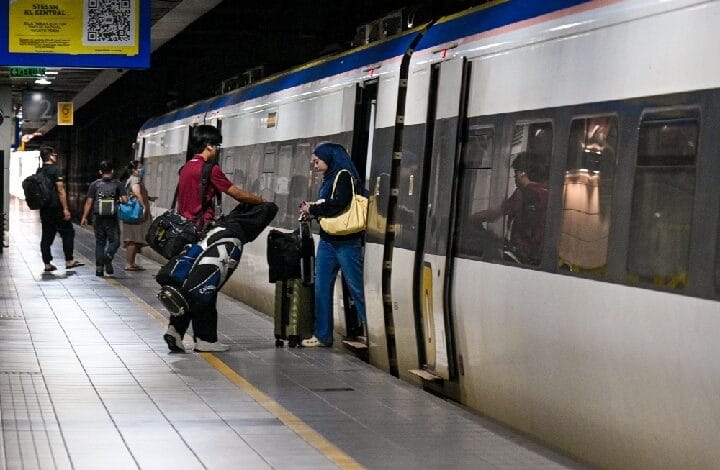
Fahmi made the announcement during a live internet speed testing exercise conducted on the KL Sentral–Segamat Electric Train Service (ETS) route. The test assessed both 4G and 5G performance, measuring factors such as download and upload speeds, connection stability and uninterrupted coverage.
Results from the assessment revealed that while significant portions of the route are covered by 5G, connectivity remains uneven. Approximately 71 per cent of the corridor has 5G access, but several segments — particularly in Negeri Sembilan, Melaka and northern Johor — continue to experience reduced signal strength and slower data speeds.
Fahmi said addressing these issues will require a collaborative approach that leverages shared infrastructure. He emphasised that telecommunications providers should utilise existing assets, including towers and passive equipment, to maximise coverage without duplicating resources.
“The focus is on delivering consistent service to users. It is not about competition, but about cooperation among providers,” he said.
To further strengthen the initiative, the government plans to convene a technical workshop involving MCMC, KTMB, RAC and industry players. The workshop will aim to identify connectivity blind spots across the entire rail network and develop both short-term and long-term solutions.
The scope of improvements extends beyond the KL–Segamat route. Fahmi highlighted that the entire KTMB network, spanning about 1,700 kilometres up to Tumpat in Kelantan, will be included in future enhancement plans.
He noted that while onboard WiFi services are already available on some trains, they are not sufficient to meet modern connectivity demands. A more integrated approach that combines multiple network providers is necessary to ensure seamless connectivity.
During the journey, Fahmi conducted speed tests at Kajang and Pulau Sebang/Tampin stations, observing firsthand the variations in network performance that passengers experience.
The initiative reflects the government’s broader effort to enhance digital inclusion and ensure that connectivity is available across all major transport corridors. Reliable internet access is increasingly seen as a necessity, particularly as more Malaysians depend on digital tools in their daily lives.
By setting a clear deadline and reinforcing accountability among service providers, the government aims to deliver tangible improvements that will enhance the overall travel experience for ETS passengers.
-wilayah.com.my