
Arctech Showcases Advanced Solar Technologies to Support Europe’s Renewable Energy Expansion

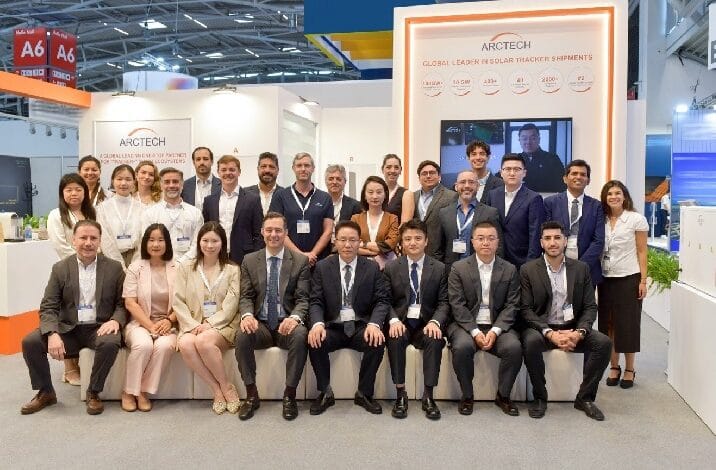
MUNICH: Arctech has reinforced its commitment to Europe’s clean energy transition by presenting its latest solar tracking and smart energy technologies at Intersolar Europe 2026, highlighting solutions designed to improve efficiency, adaptability and long-term performance across a wide range of photovoltaic projects.
During the exhibition in Munich, the company introduced its integrated “Tracker+” Ecosystem, a portfolio of technologies developed to address the evolving requirements of utility-scale solar developments as renewable energy deployment expands into increasingly challenging environments.
Arctech said Europe’s accelerating shift toward clean energy is creating demand for solar systems capable of operating efficiently across mountainous landscapes, regions with heavy wind and snow loads, and sites with varying terrain conditions. To address these challenges, the company has developed solutions that combine intelligent tracking, structural optimisation and automated maintenance technologies.
Among the technologies showcased was the SkyLine II intelligent solar tracker, engineered to improve installation flexibility and operational stability on uneven terrain. The system is intended to support developers working on projects where land conditions require greater adaptability without compromising structural performance.
The company also highlighted SkySmart II, an AI-powered dual-row solar tracking system that incorporates intelligent wind protection together with automated tracking optimisation. According to Arctech, the technology is designed to enhance both energy generation and operational safety under changing environmental conditions.
Complementing the tracking systems is Star Shine, an autonomous robotic cleaning solution developed to improve the operational efficiency of photovoltaic installations by reducing dust accumulation and lowering maintenance requirements. Arctech also presented SkyFlex, a cable management solution aimed at simplifying installation while reducing structural stress across large solar arrays.
Beyond product innovation, Arctech highlighted its growing presence across Europe through several utility-scale projects. The company has supplied solar tracking systems for developments including 342MW and 67MW projects in Romania, a 266MW installation in Greece and a 52MW project in Poland, demonstrating the adaptability of its technology across diverse regulatory and climatic environments.
The exhibition also served as the venue for announcing new project agreements with a combined capacity of 132MW in Türkiye and Zambia, extending the company’s international project portfolio beyond Europe into emerging renewable energy markets.
Supporting its regional development strategy, Arctech showcased its Arctech Verification Base (AVB) located in Puertollano, Spain. The facility enables product testing and validation under real European environmental conditions while supporting ongoing research, engineering optimisation and localisation efforts.
Chairman Cai Hao said Europe’s renewable energy sector is entering a new stage characterised by increasingly complex project requirements and broader deployment scenarios. He noted that intelligent, adaptable technologies will play an increasingly important role as developers seek to maximise energy production while improving long-term operational performance.
Arctech said it will continue investing in research and engineering capabilities to deliver advanced solar tracking solutions that support renewable energy growth across Europe and other international markets, helping partners improve project efficiency while contributing to the global transition toward cleaner and more sustainable energy systems.