
AI and 5G-Advanced Set to Reshape the Future of Voice Services, Says GlobalData at MWC 2026

BARCELONA, — The telecommunications industry is entering a new phase where artificial intelligence is expected to dramatically redefine the role of voice communication, according to a new white paper unveiled at Mobile World Congress (MWC) 2026.
The report, released by analytics firm GlobalData, examines how telecom operators can modernise voice infrastructure and unlock new digital services by integrating AI capabilities into next-generation networks.
Titled Reinventing Voice: A Converged, AI-Enabled, and Multimodal Voice Core for the Next Generation of Telecommunications, the study was introduced by Andy Hicks, Senior Principal Analyst at GlobalData, during the international technology gathering in Barcelona.
The paper argues that voice services — once considered a mature or declining segment of telecommunications — could regain strategic importance if combined with artificial intelligence and advanced network technologies.
According to Hicks, telecom providers have an opportunity to rebuild the value of voice services by adopting modern infrastructure capable of supporting innovation in the AI era.
The report highlights that telecom operators worldwide are currently navigating a complex transition period as mobile network technologies continue to evolve.
Although many countries are gradually retiring 2G and 3G networks, some operators are still required to maintain these legacy systems to support critical functions such as machine-to-machine communication and international roaming services.
This situation means operators must simultaneously manage infrastructure that supports several generations of mobile technology, including 2G, 3G, 4G and 5G.
GlobalData’s research suggests that the most effective strategy for managing this complexity is the adoption of a fully converged voice network capable of operating seamlessly across all network generations.
Such a system would allow telecom companies to streamline network management while ensuring compatibility with services that still depend on older technologies.
Beyond operational efficiency, the approach also provides a foundation for future innovation as networks continue evolving toward advanced 5G capabilities.
Another technological shift highlighted in the white paper is the growing adoption of containerisation in telecom network architecture.
The industry is increasingly transitioning from traditional virtual machine-based infrastructure to container-based environments, which allow services to be deployed more quickly and updated more efficiently.
According to the report, integrating containerisation within a converged voice infrastructure can significantly reduce operational costs while enabling telecom operators to introduce new services more rapidly.
However, the most transformative element discussed in the study is the role of artificial intelligence in redefining voice communications.
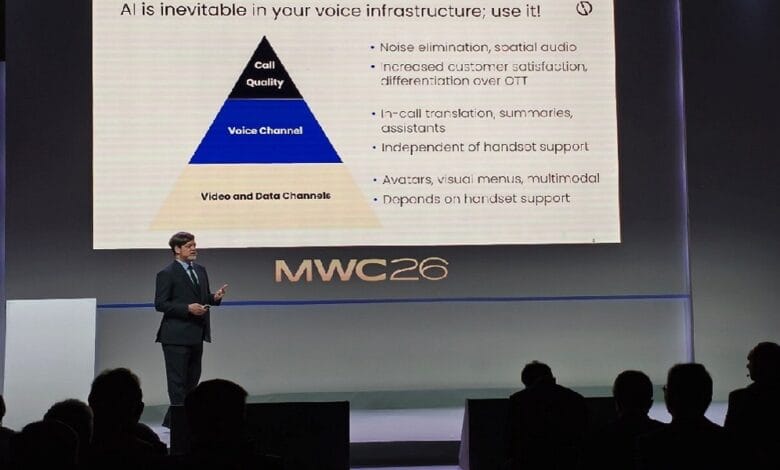
Hicks explained that AI technologies have the potential to reshape voice services through a three-phase evolution.
The first phase focuses on improving the basic voice call experience.
AI-powered technologies such as intelligent noise suppression and advanced spatial audio processing can significantly enhance sound quality, creating more natural and immersive conversations.
These improvements could help telecom operators differentiate their services from over-the-top communication platforms that currently dominate digital messaging and voice calls.
The second phase involves embedding AI capabilities directly into voice channels to introduce new intelligent features.
Examples include real-time language translation, which allows people speaking different languages to communicate seamlessly, as well as automated call summaries that help users quickly review important information from conversations.
One advantage of this approach is that these features can be deployed through network infrastructure, meaning users do not need to upgrade their devices to benefit from the services.
The final phase described in the report envisions voice services evolving into multimodal communication platforms.
In this stage, voice, video and data interactions would be integrated into a unified communication environment powered by artificial intelligence.
Such systems could support a wide range of advanced applications, including AI-driven customer service platforms, remote healthcare support and interactive digital assistants.
The report refers to this concept as “Call-as-a-Service,” where voice communication becomes a central component of broader AI-enabled digital ecosystems.
Hicks emphasised that the telecommunications sector now faces a major opportunity to revitalise voice services by combining AI technologies with next-generation network infrastructure.
Operators that embrace these developments could create new revenue streams while delivering more advanced digital experiences to users.
He added that the combination of AI innovation and 5G-Advanced network development could significantly expand the possibilities for voice communication in the coming years.
As telecom networks continue to evolve globally, the integration of artificial intelligence into voice infrastructure is expected to play a critical role in shaping the next generation of communication services.
-wilayah.com.my