
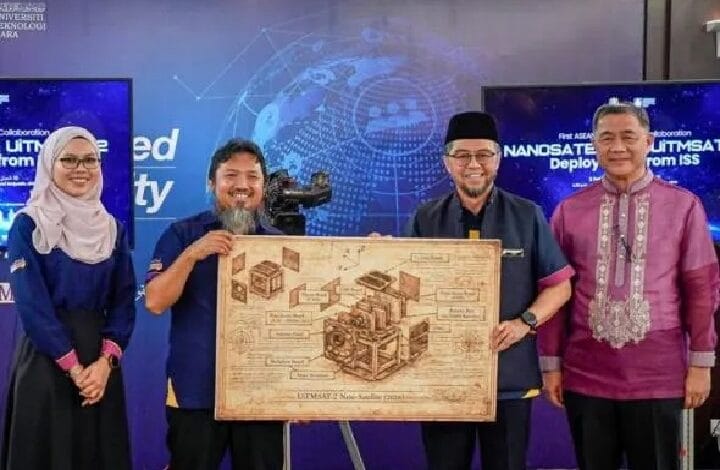
UiTMSAT-2 Successfully Deployed from ISS, Marking Major Milestone for Malaysia’s Space Programme

SHAH ALAM — Universiti Teknologi MARA (UiTM) has achieved another historic breakthrough after its second nano-satellite, UiTMSAT-2, was successfully deployed into orbit from the Stesen Angkasa Antarabangsa (ISS) at 6.52pm Malaysia time today.
The achievement represents a significant step forward in Malaysia’s efforts to build long-term capabilities in space technology and satellite engineering.
Project leader Dr Fatimah Zaharah Ali said UiTMSAT-2 is a 1U CubeSat weighing 1.1 kilograms, deployed using the Japanese Experiment Module’s Small Satellite Orbital Deployer (J-SSOD).
She explained that the satellite carries an Earth observation camera as its primary mission, alongside a space-based Internet of Things (IoT) system as a secondary objective.
“It enables sensor data transmission from remote areas without terrestrial connectivity through amateur VHF and UHF radio frequencies,” she said.
International Collaboration Strengthens Development
The deployment was broadcast live from the Japan Aerospace Exploration Agency (JAXA) and witnessed by UiTM’s senior management.
UiTMSAT-2 was previously delivered to the ISS in October 2025 via the HTV-X1 mission using Japan’s H3 launch vehicle.
Currently operating at an altitude of 380 to 400 kilometres in low Earth orbit, the satellite completes approximately 16 revolutions around the Earth every 24 hours.
Development of the project began in early 2021 and involved component procurement, circuit board design, system integration, and extensive testing.
The flight model was completed with technical support from the Kyushu Institute of Technology, including solar panel integration and environmental space testing.
The project also involved collaboration with King Mongkut’s University of Technology North Bangkok and University of Perpetual Help System DALTA.
Funding and Local Infrastructure
Funding was provided by Kementerian Sains, Teknologi dan Inovasi (MOSTI) through the International Collaboration Fund, complemented by UiTM and international partners.
UiTM also developed its own satellite integration laboratory and ground station, equipped with advanced antenna systems for real-time monitoring.
UiTM Vice-Chancellor Professor Datuk Dr Shahrin Sahib said the success of UiTMSAT-2 demonstrates Malaysia’s readiness to play a bigger role in future space technologies.
“This project reflects the strength of local expertise and the capacity of public universities to drive strategic innovation,” he said.
He added that UiTMSAT-2 represents not only technological progress, but also confidence in Malaysia’s scientific talent and engineering capabilities.
-wilayah.com.my