
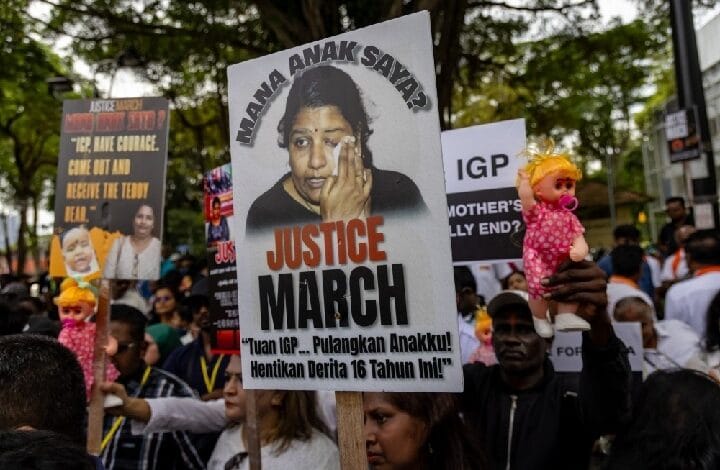
Government Challenges 2018 Ruling on Child Conversion in Indira Gandhi Case

KUALA LUMPUR — The federal government has argued in the High Court that the conversion of a minor to Islam requires the consent of only one parent, not both, in a move that challenges the landmark 2018 Federal Court ruling involving Indira Gandhi.
Senior federal counsel Ahmad Hanir Hambaly submitted that the word “parent” in Article 12(4) of the Federal Constitution should be interpreted in the singular form.
He said this interpretation allows either the mother or the father to decide a child’s religion independently.
The argument was raised during the hearing of a new lawsuit filed by Indira Gandhi and 13 other plaintiffs, who are challenging the constitutionality of state laws in seven states that permit unilateral conversions.
The states involved are Perlis, Kedah, Melaka, Negeri Sembilan, Perak, Johor, and the Federal Territories.
The plaintiffs rely on the 2018 Federal Court ruling, which held that “parent” must be read in the plural, requiring consent from both parents.
However, Hanir maintained that the 2018 decision was specific to Indira’s case and should not be applied universally.
He argued that imposing a blanket rule of mutual consent oversimplifies the complex issue of child welfare.
“Each case must be assessed based on its own circumstances and the best interests of the child,” he told the court.
In their suit, the plaintiffs are seeking a declaration that all unilateral conversions carried out in the affected states since 2018 are invalid.
They are also asking for such conversions to be reversed if either parent objects.
The case marks the latest chapter in Indira’s nearly 18-year legal struggle to reunite with her daughter, Prasana Diksa.
Her former husband, Riduan Abdullah, allegedly abducted the child in 2009 after converting all three children to Islam without her consent.
In 2018, the Federal Court annulled the conversions and ordered the police to arrest Riduan and recover the child.
To date, both Riduan and Prasana remain missing.
High Court Judge Aliza Sulaiman has fixed May 21 for her decision on the current lawsuit.
Legal observers say the case could have far-reaching implications for constitutional interpretation, parental rights, and the balance between civil and religious laws in Malaysia.
-wilayah.com.my