AGIBOT Reaches 15,000-Robot Production Milestone as Embodied AI Moves Toward Large-Scale Industrial Deployment

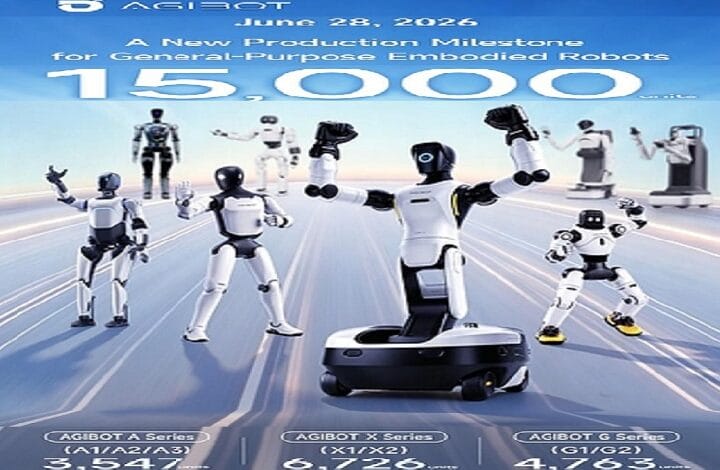
SHANGHAI: Chinese robotics company AGIBOT has reached another manufacturing milestone after announcing that its 15,000th embodied AI robot has rolled off the production line, highlighting the company’s continued expansion from product development into large-scale commercial production and deployment.
The latest milestone comes just over three years after the company was founded in February 2023 and reflects the rapid pace at which embodied artificial intelligence technologies are entering industrial applications. According to AGIBOT, the milestone unit is its AGIBOT G2, an industrial-grade embodied task robot developed for factory operations and other real-world working environments.
The company said the latest achievement represents more than an increase in manufacturing output. It also signals growing confidence in the commercial deployment of embodied AI systems as manufacturers increasingly explore automation capable of performing complex physical tasks alongside human workers.
AGIBOT has recorded a series of production milestones within a relatively short period. After producing its first 1,000 robots, the company expanded to 5,000 units before reaching 10,000 units only a few months later. The latest increase to 15,000 units demonstrates the company’s continued manufacturing expansion as demand for intelligent robotics solutions grows across industrial sectors.
Company executives said the latest production milestone reflects progress in engineering, manufacturing and operational deployment rather than simply an increase in factory capacity. The business has continued investing in product development, supply chain management, quality control systems and software-hardware integration to support larger production volumes while maintaining product consistency.
Unlike conventional industrial machines, embodied AI robots combine advanced hardware with artificial intelligence capable of interacting with dynamic environments. As a result, large-scale production requires not only manufacturing capability but also engineering expertise covering robot assembly, software integration, testing procedures and deployment support for customers.
AGIBOT also highlighted recent operational demonstrations involving the AGIBOT G2. The company reported completing around 100 cumulative hours of factory livestream operations, during which the robot carried out quality inspection tasks within a consumer electronics manufacturing environment while working alongside production personnel. The demonstration was intended to showcase the robot’s ability to operate under actual factory conditions rather than laboratory testing scenarios.
The company’s progress has also been supported by its market performance. AGIBOT cited research from market intelligence firm Omdia indicating that it ranked first globally in humanoid robot shipments during 2025, recording annual shipments of 5,168 units and accounting for 39 per cent of the global market. While shipment figures and production output measure different aspects of business performance, the company believes the combination reflects its growing position within the emerging embodied AI industry.
Industry observers increasingly view embodied AI as one of the next major developments in industrial automation, particularly as manufacturers seek robots capable of adapting to more flexible production environments. Instead of focusing solely on repetitive tasks, newer robotic platforms are being designed to perform multiple functions while interacting safely with people in complex workplaces.
AGIBOT believes the industry’s next stage will be defined less by prototype demonstrations and more by the ability to manufacture, deliver and deploy robots at commercial scale. As embodied AI technologies continue to mature, companies are expected to compete not only on innovation but also on manufacturing capacity, deployment capability and long-term operational reliability.
With production now reaching 15,000 units, AGIBOT has positioned the milestone as another step in its strategy to accelerate the industrial adoption of embodied AI, while reinforcing its focus on expanding deployments across manufacturing and other real-world operating environments.