
Open-Source Medical Video AI Breakthrough Aims to Transform Global Healthcare Collaboration

SHANGHAI, April 24 — United Imaging Intelligence has introduced a next-generation open-source medical video language model, positioning it as a major step toward more collaborative and intelligent healthcare systems worldwide.
The model, uAI NEXUS MedVLM, is engineered to analyse complex medical video data with high spatial and temporal accuracy, enabling it to interpret intricate clinical procedures and workflows. Its unveiling is accompanied by a global call to action, encouraging researchers, developers and medical institutions to contribute to its continuous improvement.
The research behind the model has been accepted at CVPR 2026, reflecting strong validation from the international artificial intelligence research community.
Built on a large-scale dataset of over 500,000 annotated video-instruction pairs, the system is capable of understanding detailed clinical scenarios such as robotic surgery, laparoscopic procedures and patient care activities. This extensive dataset allows the model to capture fine-grained details, including instrument motion, spatial relationships and procedural timing.
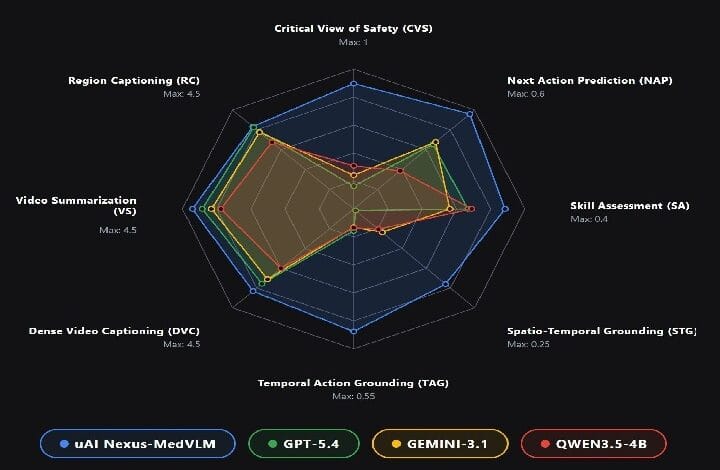
According to its developers, the model delivers strong performance across critical medical video tasks, including safety assessment, action localisation and automated report generation. By transforming raw video data into structured clinical outputs, it offers a powerful tool for healthcare professionals.
A central feature of the initiative is its open-source framework, which is designed to lower barriers to entry and accelerate innovation. By enabling global participation, the project aims to build a collaborative ecosystem where new ideas and improvements can be rapidly integrated.
To support this effort, United Imaging Intelligence has launched a benchmarking platform known as MedVidBench. The platform provides a standardised evaluation environment, allowing developers to test their models against shared datasets, with results published on a transparent global leaderboard.
One of the longstanding obstacles in medical AI development has been the limited availability of high-quality annotated video data. By constructing a comprehensive dataset with detailed frame-level annotations, the company has addressed a critical gap in the field.
Beyond analysis, the model is designed to assist in clinical workflows by generating structured reports, identifying potential risks and supporting training and performance evaluation for healthcare professionals.
Experts believe such advancements could significantly enhance decision-making processes, improve training efficiency and contribute to more consistent and standardised medical practices.
Looking forward, the technology could serve as a foundation for integrating AI with robotic systems, creating a more advanced healthcare ecosystem that combines perception, reasoning and physical execution.
-wilayah.com.my