
Nadma Conducts Cloud Seeding Operations At Five Critical Dams In Northern Malaysia

PETALING JAYA: The National Disaster Management Agency has launched cloud seeding operations at five major dams in Kedah and Perlis following a worrying decline in water levels that have now reached alert and critical stages.
The emergency measure is aimed at increasing water storage capacity in northern Peninsular Malaysia amid growing concerns over potential disruptions to agricultural and domestic water supplies.
In a statement issued today, the National Disaster Management Agency said the operations involve Timah Tasoh Dam in Perlis and four major dams in Kedah — Ahning Dam, Pedu Dam, Beris Dam and Muda Dam.
According to the agency, the cloud seeding programme will be carried out in two phases, beginning from May 10 to May 12 before continuing again from May 17 to May 19.
Authorities decided to proceed with the operation after monitoring showed that water levels at several key reservoirs continued to decline despite recent rainfall recorded in northern parts of the country.
“The cloud seeding operation is being implemented in Kedah and Perlis as an immediate measure to address declining water levels at dams currently categorised as being at alert and critical levels,” the statement said.
The agency explained that operations began as early as 8am today when technical personnel from the Malaysian Meteorological Department prepared salt solution mixtures before loading them onto an aircraft.
Operational teams were also briefed on the target zones and flight procedures before the mission commenced.
The operation utilised a Lockheed C-130 Hercules aircraft belonging to the Royal Malaysian Air Force carrying four barrels containing approximately 6,000 litres of salt solution for cloud seeding activities.
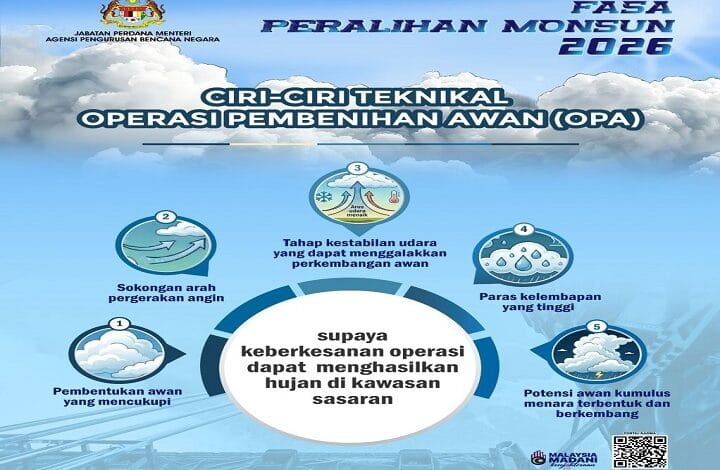
According to Nadma, cloud seeding is one of the methods used by the government to stimulate rainfall formation over dam catchment areas, especially during prolonged dry weather and periods of declining water reserves.
The agency noted that although several northern areas recently experienced rainfall, the amount of water flowing into the dams remained insufficient to significantly restore reservoir levels.
“The situation could potentially affect water supply for agricultural and domestic usage if dam levels continue to decline,” it added.
The dams in Kedah and Perlis are crucial to Malaysia’s agricultural sector, particularly for rice cultivation activities in the country’s northern granary regions.
Kedah remains one of Malaysia’s largest rice-producing states and relies heavily on stable water supply systems to sustain paddy farming throughout planting seasons.
Apart from agriculture, water from these dams is also essential for daily household use and industrial activities across northern states.
Concerns over declining reservoir levels have intensified in recent months due to prolonged hot weather and increasingly unpredictable rainfall patterns.
Global climate change is also believed to be contributing to rising temperatures and shifts in rainfall distribution throughout the region.
Over the years, Malaysia has repeatedly conducted cloud seeding operations during severe drought periods, haze crises and situations involving critically low dam water levels.
The technique involves dispersing substances such as salt particles into clouds to accelerate the formation of rain droplets.
However, the effectiveness of cloud seeding depends heavily on atmospheric conditions and the presence of suitable cloud formations capable of producing rainfall.
The National Disaster Management Agency said it will continue monitoring water levels at affected dams in collaboration with relevant agencies to ensure national water supply conditions remain under control.
-wilayah.com.my