AAVnerGene Launches Advanced Gene Therapy Manufacturing Platform To Improve Scalability And Reduce Costs

ROCKVILLE, Maryland: AAVnerGene has introduced a next-generation manufacturing platform known as AAVone 2.1 aimed at improving AAV vector production efficiency, enhancing product quality and reducing manufacturing costs within the global gene therapy industry.
The biotechnology company said the newly launched platform represents the latest evolution of its proprietary AAVone technology, which uses a single-plasmid approach for producing adeno-associated virus (AAV) vectors widely used in modern gene therapy applications.
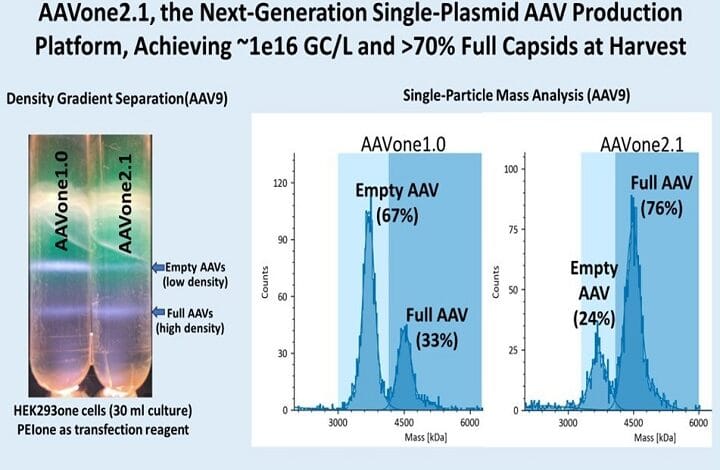
According to AAVnerGene, the AAVone 2.1 system achieved approximately 1×10¹⁶ genome copies per litre of cell culture while delivering more than 70 per cent full capsids during harvest.
The performance represents a significant improvement over conventional multi-plasmid AAV manufacturing systems, which often generate high levels of empty capsids and require more complicated purification procedures.
The company said the new platform demonstrated compatibility across multiple AAV serotypes and can integrate with existing HEK293-based manufacturing systems commonly used in the biotechnology sector.
According to AAVnerGene, the improved productivity and full-capsid ratio could reduce plasmid usage, cell culture volume, processing time and purification burden during manufacturing.
The advancements are expected to lower overall production costs while improving the quality and efficiency of gene therapy vector production.
Chief Technology Officer Qizhao Wang said AAV manufacturing remains one of the biggest technical and commercial challenges in gene therapy development.
He explained that traditional multi-plasmid production systems have supported the industry for decades but continue to face limitations involving productivity, empty capsid generation and purification complexity.
“AAVone 2.1 was developed to overcome these challenges through a simplified single-plasmid approach capable of improving vector productivity and full-capsid ratios,” he said.
Meanwhile, Daozhan Yu, chief executive officer of AAVnerGene, said the gene therapy industry continues to face major obstacles in achieving broader commercialisation.
He noted that manufacturing cost, scalability limitations and vector quality remain among the biggest barriers affecting many gene therapy programmes.
According to him, the AAVone 2.1 platform has the potential to make AAV manufacturing simpler, more scalable and significantly more cost-efficient.
“This technology could help more gene therapy programmes become clinically and commercially viable,” he said.
AAV-based gene therapy is increasingly regarded as one of the most promising approaches for treating genetic disorders, neurological diseases and rare conditions that remain difficult to address using conventional treatments.
However, large-scale AAV vector manufacturing remains expensive and technically demanding, creating substantial challenges for biotechnology and pharmaceutical companies.
Manufacturing systems capable of increasing production yield while reducing empty capsid formation are considered essential for accelerating therapy development and lowering treatment costs for patients.
According to AAVnerGene, several industry partners have already licensed the technology and are currently developing multiple AAV-based gene therapy programmes using the platform.
The company said its long-term objective is to help the gene therapy industry overcome manufacturing limitations, accelerate treatment development and expand patient access to future gene therapies.
-wilayah.com.myhttp://wilayah.com.my