
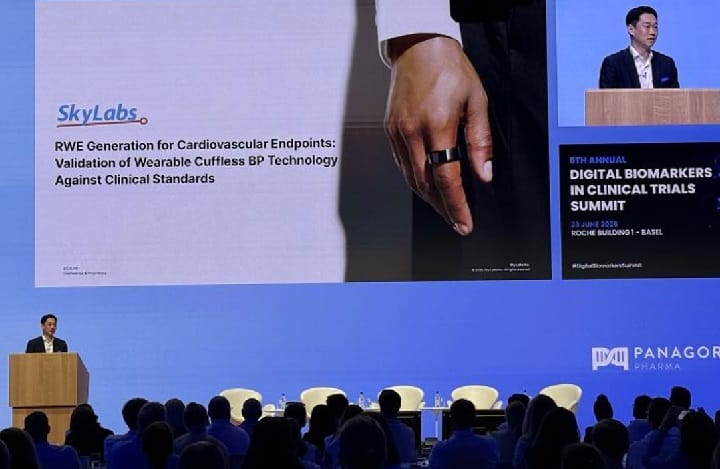
Sky Labs Promotes Wearable Blood Pressure Technology for Global Clinical Research Applications

BASEL, Switzerland/SEOUL, South Korea, July 7 — Medical technology company Sky Labs is positioning its wearable blood pressure monitoring platform as a tool to support the next generation of pharmaceutical research, highlighting how continuous patient monitoring could improve clinical trials and the collection of real-world health data.
The company presented its ring-based CART BP pro monitoring system during the 9th Digital Biomarkers in Clinical Trials Summit in Basel, where researchers, pharmaceutical companies and digital health specialists gathered to discuss the expanding role of wearable technologies in drug development.
The annual conference brought together representatives from global pharmaceutical firms, clinical research organisations and healthcare technology companies to examine how digital biomarkers and connected medical devices can enhance clinical trial design and patient monitoring.
According to Sky Labs, the event provided an opportunity to demonstrate how wearable devices could complement traditional clinical research methods by enabling continuous collection of physiological data outside conventional healthcare settings.
Central to the company’s presentation was the CART BP pro, a cuffless blood pressure monitor worn on a finger in the form of a ring.
Unlike conventional ambulatory blood pressure monitoring systems that rely on inflatable arm cuffs, the wearable device is designed to collect blood pressure and heart rate measurements during both daily activities and sleep without repeated arm compression.
Sky Labs argued that this approach may improve patient comfort while allowing researchers to obtain more consistent long-term physiological data throughout clinical studies.
The company noted that conventional 24-hour ambulatory blood pressure monitors can sometimes interfere with participants’ sleep because of repeated cuff inflation, potentially affecting both patient compliance and data collection during clinical trials.
By reducing discomfort associated with traditional monitoring methods, wearable devices could help improve participant retention while supporting more complete data collection across longer study periods.
Beyond clinical trials, Sky Labs also highlighted opportunities for wearable monitoring technologies to contribute to the growing field of real-world evidence (RWE).
Continuous monitoring allows researchers to evaluate how blood pressure changes over time in relation to medication schedules, treatment adherence and daily lifestyle patterns, providing additional information that may support assessments of drug effectiveness and safety after products reach the market.
The company believes such capabilities could expand the role of wearable devices throughout the pharmaceutical product lifecycle, extending beyond drug development into post-market clinical evaluation.
Sky Labs said its data platform strategy has already gained practical experience in South Korea, where the technology has been incorporated into a large-scale cohort study conducted under the country’s national public health research programme.
The company views these projects as demonstrating the broader potential of wearable monitoring systems within population health research as well as pharmaceutical development.
According to Sky Labs, the CART BP pro has also achieved regulatory and clinical recognition in South Korea.
The device is currently covered under the national health insurance system and has been included in updated hypertension management guidelines issued by the Korean Society of Hypertension, supporting its use in clinical practice as a certified cuffless blood pressure monitoring solution.
Looking ahead, the company plans to expand collaborations with international pharmaceutical organisations as interest grows in digital health technologies capable of generating continuous, patient-centred clinical data.
Sky Labs said it intends to build additional partnerships supporting clinical trials while further developing its digital health platform for broader use across medical research.
As wearable medical technologies continue gaining acceptance within healthcare systems and pharmaceutical research, the company believes continuous remote monitoring will become an increasingly valuable component of future clinical studies, helping researchers improve data quality while enhancing the overall experience for trial participants.