
X Square Robot Open-Sources XRZero-G0 to Accelerate Embodied AI and Scalable Robot Learning

SHENZHEN: Robotics company X Square Robot has unveiled the open-source release of XRZero-G0, a comprehensive framework designed to accelerate the development of embodied artificial intelligence by enabling large-scale, high-quality data collection without relying entirely on physical robots.
The announcement also includes the launch of G0-Dataset, a validated multimodal dataset generated through the XRZero-G0 framework, providing researchers worldwide with access to thousands of hours of training data aimed at advancing next-generation robotic intelligence.
The move addresses one of the most significant challenges facing the robotics industry today: the shortage of high-quality training data.
Traditionally, collecting data for robot learning requires extensive teleoperation of physical robots, a process that is both costly and time-consuming. Such methods often produce only a limited number of demonstrations each day, restricting the speed at which AI systems can be trained and improved.
While robot-free data collection has emerged as a promising alternative, many existing approaches struggle with inconsistencies in data quality and limited integration with machine learning pipelines.
XRZero-G0 was developed to bridge that gap by combining data collection, quality validation, policy training and real-world evaluation into a unified framework.
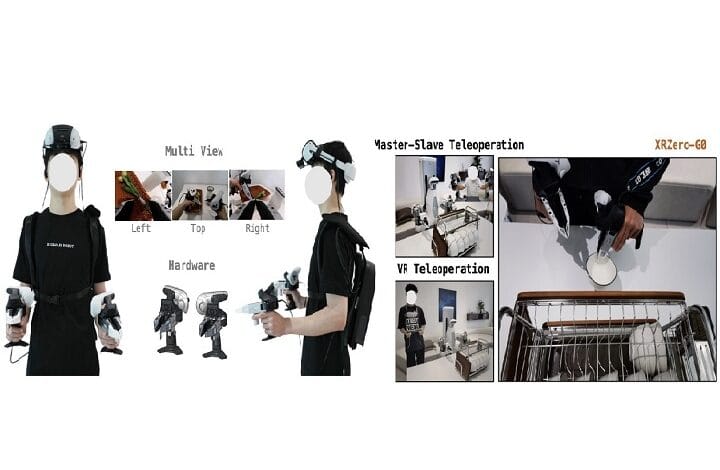
One of its key innovations is a multi-view sensing architecture designed to replicate how robots perceive their environment.
The system incorporates a head-mounted camera alongside dual wrist-mounted cameras, allowing it to capture both broad environmental context and detailed hand-object interactions simultaneously.
These observations are synchronised and translated into representations that align closely with robot perception systems, reducing discrepancies between training environments and real-world deployment.
The platform also includes a wearable virtual reality interface and interchangeable grippers, enabling human operators to generate demonstrations that can be transferred across multiple robotic platforms.
This approach significantly increases data collection efficiency while reducing dependence on physical robots during the early stages of development.
To ensure data quality, XRZero-G0 employs a closed-loop validation process that evaluates visual consistency, motion accuracy, collision avoidance and joint constraints before demonstrations are approved for training purposes.
Final validation is then conducted through real-robot execution, ensuring that learned behaviours remain practical and deployable in real-world conditions.
According to X Square Robot, the framework achieves an effective data usability rate of approximately 85 per cent under controlled testing conditions, substantially increasing the proportion of demonstrations suitable for AI training.
Researchers involved in the project also identified an important relationship between robot-free and real-robot data.
Their findings suggest that combining approximately ten robot-free demonstrations with a single real-robot demonstration can deliver performance comparable to models trained entirely on physical robot data.
This strategy provides broad behavioural learning while allowing smaller quantities of real-world data to account for platform-specific characteristics such as motor response, friction and mechanical limitations.
Under experimental conditions, the approach reduced the need for real-robot training data by as much as twenty times.
Building on the framework, G0-Dataset offers more than 2,000 hours of validated multimodal demonstrations spanning vision, tactile sensing and audio inputs.
The dataset is intended to support large-scale AI pretraining, cross-platform learning and broader robotics research initiatives.
Experiments conducted by the company indicate that models trained using XRZero-G0 demonstrate strong adaptability across different operating conditions, including varying viewpoints, robot positions and workspace configurations.
Researchers also observed promising zero-shot transfer capabilities, allowing trained policies to function on previously unseen robot platforms without requiring task-specific retraining.
By releasing both XRZero-G0 and G0-Dataset as open-source resources, X Square Robot aims to provide the global research community with practical tools, datasets and methodologies that can accelerate progress toward more capable, scalable and general-purpose robotic systems powered by embodied AI.