
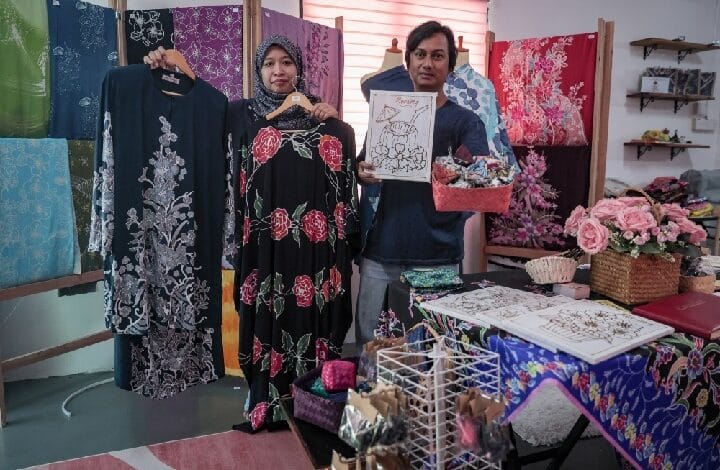
Johor-Inspired Batik Studio in Mersing Emerges as Cultural Tourism Draw

MERSING, April 29 — A homegrown batik studio in Johor is gaining traction among tourists by blending traditional craftsmanship with locally inspired designs, turning a quiet coastal town into a niche cultural destination.
Founded by Nadia Mohd Fuzi, Rumah Batik Sri Wangsa offers visitors an immersive experience in batik-making, allowing them to create their own patterns using the traditional canting technique.
After more than a decade in the batik and handicraft trade in Johor Bahru, Nadia decided to shift from retail to production, launching her own line of batik fabrics about three years ago. Together with her husband, Haiyat Md Hassim, she returned to her hometown of Mersing to develop the business.
Her creations stand out for their distinctive motifs inspired by Johor’s natural and agricultural identity, including pineapples, black pepper and the berembang tree, alongside classic floral and geometric patterns.
Driven by growing interest in experiential tourism, the studio introduced hands-on workshops last year, enabling visitors to participate directly in the batik-making process. The initiative has since attracted strong interest, particularly from international tourists.
Nadia noted that nearly 80 per cent of visitors to the centre come from abroad, many of whom include the studio as a key stop during their visit to Mersing, a town better known as a gateway to nearby islands.
“Mersing has its own charm that is often overlooked,” she said, adding that the combination of art, culture and tourism has helped position her studio as a unique attraction in the area.
The business, which began with an initial investment of about RM80,000, has expanded steadily, supported by increasing demand for authentic, locally produced batik. The studio now employs a small team of trained artisans, many of whom received formal training from Kraftangan Malaysia.
Beyond individual visitors, Rumah Batik Sri Wangsa has also become a popular venue for group activities, hosting programmes for schools, government agencies and private organisations, including team-building sessions and educational workshops.
Unlike many small-scale batik producers who operate from home-based workshops, Nadia’s facility is designed to accommodate larger groups, making it suitable for tour buses and organised visits.
Her journey into batik-making was influenced by family tradition, having learned the craft under the guidance of an uncle with decades of experience in the field.
She explained that batik production involves several techniques, including canting, block printing, screen printing and tie-dye, each contributing to the diversity of designs and textures.
Looking ahead, Nadia and her husband plan to further develop the studio into a comprehensive cultural hub. Expansion plans include upgrading the learning centre, enlarging production facilities and building a dedicated gallery to showcase batik art.
Among their long-term goals is the construction of a two-storey glass gallery that combines modern design with traditional elements, aimed at establishing a new landmark for cultural tourism in Mersing.
The couple is also exploring opportunities to expand into international markets, while continuing efforts to preserve and promote batik as part of Malaysia’s cultural heritage.
As visitor numbers continue to grow, Rumah Batik Sri Wangsa reflects how small creative enterprises can play a significant role in enhancing local tourism and sustaining traditional crafts in a modern context.
-wilayah.com.my