
Huawei Outlines Vision for AI-Centric All-Optical Networks to Power Next-Generation Digital Services
New optical infrastructure strategy focuses on faster speeds, stronger reliability and ultra-low latency

BARCELONA, March 5 — Huawei has unveiled its vision for an AI-centric all-optical network designed to power the next generation of digital services and significantly improve user connectivity experiences.
The proposal was presented during the Green All-Optical Network Forum held alongside Mobile World Congress (MWC) Barcelona 2026, a major global technology event that gathers leading telecommunications companies, policymakers and industry experts.
Huawei’s strategy focuses on strengthening network infrastructure through improvements in four critical areas: bandwidth capacity, reliability, coverage and latency.
By enhancing these capabilities, the company aims to help telecommunications operators unlock greater value from their networks while supporting the rapid growth of AI-driven services.
The forum attracted more than 200 industry leaders and experts, including representatives from European telecom regulators, the FTTH Council, network operators and technology vendors.
Major global operators such as Bouygues Telecom and China Unicom also shared their experiences in deploying all-optical networks to support emerging digital applications.
Discussions at the forum explored the increasing network demands created by smart home services, the importance of efficient computing infrastructure for AI innovation and the need for smarter network operations.
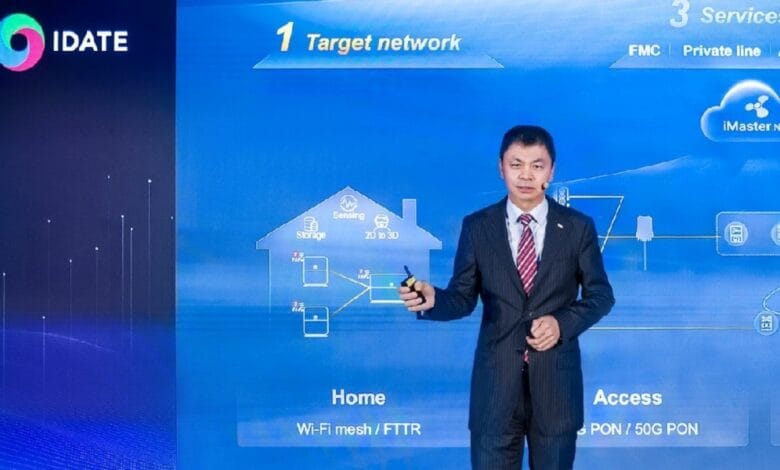
Huawei Vice President of Optical Business Product Line Kim Jin presented the company’s roadmap for building next-generation optical networks capable of supporting the growing AI ecosystem.
According to Kim, the AI era requires network infrastructure that can process massive volumes of data with extremely high speed, stability and reliability.
To address these demands, Huawei introduced several advanced optical network technologies designed to help operators deliver premium digital service experiences.
Among the key innovations is Huawei’s Wi-Fi 7 tri-band FTTR solution, which enhances home network connectivity by providing stable speeds of up to 4 Gbps in every room.
The technology also enables seamless roaming within a home network in under 10 milliseconds, ensuring uninterrupted connectivity for users.
Huawei has also developed a new Wi-Fi mesh solution integrated with AI-based anti-interference technology.
This system allows wireless signals to penetrate additional walls and increases network speed by up to 20 percent in environments with heavy interference.
In optical access networks, Huawei proposed deploying next-generation Passive Optical Network (PON) technologies capable of delivering significantly lower latency and higher bandwidth.
The system uses innovations such as application-level PON slicing and Wi-Fi air-interface scheduling to create dedicated assurance channels for priority applications.
This allows telecom operators to provide differentiated network performance for demanding digital services such as artificial intelligence applications, virtual reality platforms and ultra-high-definition streaming.
Huawei also introduced a new Optical Cross-Connect (OXC) solution designed for metro networks.
The technology extends full optical switching capabilities to city-level networks, reducing end-to-end latency and enabling mesh network architectures that support millisecond-level computing for AI workloads.
To address global data traffic growth, Huawei emphasised the importance of upgrading backbone infrastructure to 400G and 800G transmission technologies.
Its proposed 3D-mesh backbone architecture, combined with Super C+L band technology and advanced submarine cable transmission systems, significantly expands network capacity and improves cross-border data connectivity.
Huawei also highlighted the importance of building “zero-outage” optical networks capable of supporting always-on AI services.
Advanced algorithms, coordinated hardware-software upgrades and eOTDR monitoring technologies allow operators to detect network risks early and respond quickly.
Meanwhile, new liquid crystal materials enable wavelength-switched optical networks to perform switching within 50 milliseconds, greatly enhancing reliability.
In terms of network operations and maintenance, Huawei introduced intelligent agents such as FANSpirit and OTNSpirit.
The FANSpirit agent is designed to reduce complaints from home broadband users, while OTNSpirit recommends optimal network paths based on bandwidth, latency and reliability requirements.
These intelligent systems help telecom operators manage networks more efficiently while improving service quality for users.
Kim Jin said the rise of artificial intelligence represents a major opportunity for telecom operators to transform their infrastructure and unlock new value from their networks.
Huawei, he added, remains committed to working with industry partners worldwide to build AI-centric all-optical networks that deliver superior connectivity and drive innovation in the digital era.
-wilayah.com.my