Hadi Awang Defends PAS Outreach to Umno, Says Malay-Muslim Unity Remains Party’s Political Priority

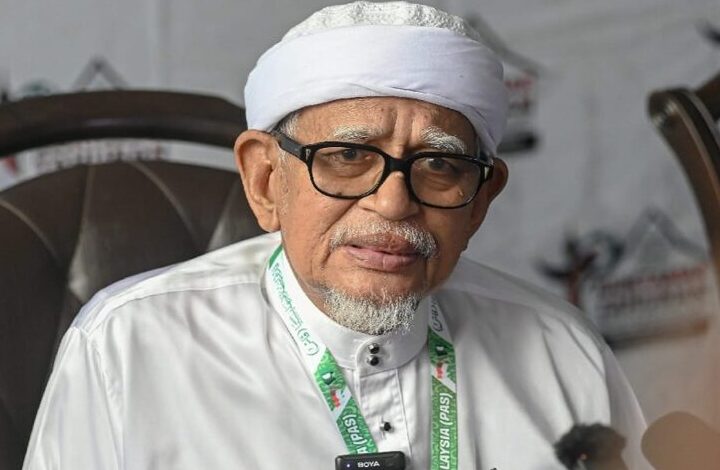
KUALA LUMPUR: PAS president Tan Sri Abdul Hadi Awang has defended the party’s continued efforts to cooperate with Umno, arguing that political collaboration should be viewed as part of a broader mission to strengthen Malay-Muslim unity rather than as a tactical electoral arrangement.
In his latest Minda Presiden PAS commentary, Abdul Hadi said the party’s approach is rooted in its belief that unity among Muslims is essential for maintaining political strength and stability, particularly in Malaysia’s evolving political landscape.
He rejected suggestions that any potential cooperation between Perikatan Nasional (PN) and Barisan Nasional (BN) should be interpreted merely as political manoeuvring ahead of future elections.
Instead, he said such efforts should be understood within the context of fostering solidarity among the Malay-Muslim community.
According to Abdul Hadi, divisions within the Muslim community have historically weakened political influence and leadership, citing episodes from Islamic history in which internal conflict contributed to the decline of Muslim civilisations.
He said Islam encourages cooperation and unity among the ummah, describing such efforts as consistent with religious teachings.
Reflecting on PAS’ political history, Abdul Hadi noted that the party has previously cooperated with a wide range of political partners under different political circumstances.
He recalled PAS’ cooperation with Umno before and after Malaysia’s independence, including its participation in the Alliance coalition, but said those partnerships eventually ended because of disagreements over principles and political commitments.
The PAS president also revisited the party’s past alliances with opposition parties, including Barisan Alternatif, which brought together PAS, Parti Keadilan Nasional, Parti Rakyat Malaysia and DAP following the 1999 general election.
He said the coalition later weakened after differences emerged over PAS’ advocacy of an Islamic state.
Similarly, Abdul Hadi pointed to the eventual collapse of Pakatan Rakyat after disagreements involving PAS, PKR and DAP over issues including the implementation of syariah laws in Kelantan and Terengganu.
Following those developments, PAS became one of the founding members of Perikatan Nasional together with Parti Pribumi Bersatu Malaysia (Bersatu) and other political parties.
Abdul Hadi described the coalition’s performance in the 15th General Election (GE15) as evidence of strong support from Malay-Muslim voters, noting that PAS emerged as the single party with the largest number of parliamentary seats while also participating in the administration of four state governments.
Looking ahead, he argued that Malaysia’s political environment requires cooperation not only among Malay Muslims but also with non-Muslim communities that embrace moderation and reject extremism.
He said PAS seeks to pursue what he described as a balanced political approach inspired by Islamic leadership principles while promoting national stability.
Abdul Hadi also explained that PAS adjusts its electoral strategy according to political circumstances in each state.
He described the party’s participation in the Johor state election as primarily aimed at strengthening Malay unity, while portraying its campaign in Negeri Sembilan as an effort to challenge the Pakatan Harapan-led state administration.
Concluding his remarks, Abdul Hadi maintained that leadership by Malay Muslims should not be interpreted as racial supremacy, arguing that Islamic principles emphasise justice, reject racial fanaticism and uphold fairness for all communities.