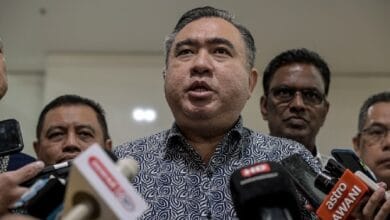

Government Focuses on Policy Adjustments as Global Supply Crisis Enters Prolonged Stress Phase — Akmal Nasrullah Mohd Nasir

KUALA LUMPUR: The government is intensifying efforts to recalibrate policy measures to manage rising cost pressures while ensuring the continued availability of essential goods, as the global supply crisis evolves into a more prolonged and complex challenge.
Economy Minister Akmal Nasrullah Mohd Nasir said the current situation has moved beyond a short-term shock and is now characterised by sustained economic stress affecting multiple sectors.
He noted that developments in the Strait of Hormuz have yet to show a convincing resolution, despite ongoing diplomatic efforts.
“The issue is not limited to physical supply disruptions, but also involves risk premiums, insurance costs, logistics, delivery delays, and broader disruptions to global supply chains,” he said during a daily briefing.
Akmal explained that the crisis has extended beyond oil prices, now impacting energy costs, raw materials, food, services, and ultimately the daily lives of the public.
“In other words, we are now managing a prolonged stress phase rather than an initial shock phase,” he said.
He added that if global uncertainties persist, the impact on energy costs and supply chains could take up to 18 months to stabilise, depending on geopolitical developments and the recovery of global trade routes.
“This means Malaysia is not immune to global pressures coming from multiple fronts,” he said.
In terms of market developments, Akmal highlighted that the global Brent crude oil spot price declined by 11.6 per cent between April 13 and 17, 2026, from US$31.67 per barrel to US$17.85 per barrel.
However, the weekly peak still reached US$32.46 per barrel, although lower than the high of US$44.46 recorded following the onset of the West Asia crisis.
These price movements suggest that uncertainty remains elevated and that pressure on energy markets is likely to persist in the near term.
On the domestic front, Akmal noted that Malaysia’s economic fundamentals remain relatively strong despite external challenges.
The FBM KLCI closed at 1,695.21 points on April 17, 2026, showing a modest increase compared to the previous week and maintaining a positive trend over recent weeks.
He also pointed to preliminary gross domestic product (GDP) estimates indicating that Malaysia’s economy is expected to grow by 5.3 per cent in the first quarter of 2026, up from 4.4 per cent in the same period last year.
This performance aligns with market expectations and is projected to outperform several regional economies.
However, Akmal cautioned against interpreting these figures as a sign that economic pressures have subsided.
“Instead, they indicate that the economy is still holding up despite ongoing external pressures that have yet to fully ease,” he said.
-wilayah.com.my


![Woman in a light blue gown with gold embroidery and a silver halo headpiece, posing gracefully.", "Two side-by-side portraits of a woman in an ornate hijab dress with beaded sleeves and a metallic halo.", "Elegant blue gown with sparkling embellishments and a crown-like silver halo worn by a hijab-clad model.", "Portraits of a woman in a richly decorated blue dress with tassels and a radiant silver halo.", "Hijab-clad model wearing a beaded blue gown with a jeweled crown-like headpiece, posing confidently."]} }aissez?{](https://wilayah.com.my/wp-content/uploads/2026/07/siti-nurhaliza-2-390x220.jpg "siti nurhaliza 2 - Wilayah.com.my")