
Bahasa Melayu Continues Rising As A Global Language Of Culture And Knowledge

KUALA LUMPUR — Bahasa Melayu is steadily gaining stronger international recognition as the language expands beyond its traditional Nusantara roots into academic, cultural and digital spheres across the world.
Long regarded as one of Southeast Asia’s most influential languages, Bahasa Melayu once served as the primary medium of communication during the era of the Srivijaya Empire and later flourished under the Malacca Sultanate as a language of administration, diplomacy and trade.
Today, linguists estimate that more than 290 million people worldwide use Bahasa Melayu and Bahasa Indonesia, placing them among the world’s most widely spoken languages.
Experts believe the language’s growing international influence reflects both its historical importance and its increasing relevance in modern global society.
Deputy President of the Malaysian Linguistics Association, Rozaimah Rashidin, said Bahasa Melayu has successfully crossed geographical boundaries through migration, trade and cultural exchange.
Malay-speaking communities are now present in regions including Australia’s Cocos (Keeling) Islands and Christmas Island, as well as South Africa, Sri Lanka, Europe and North America.
Simple Structure Helps Global Appeal
Rozaimah said one of the language’s greatest strengths lies in its accessible grammar system, making it comparatively easier for foreigners to learn and practise.
She noted that many international workers and visitors in Malaysia are able to communicate fluently in Bahasa Melayu within a relatively short time.
Social media has also accelerated the language’s visibility globally, with tourists, influencers and digital creators increasingly using Bahasa Melayu in online content and public interactions.
The late scholar Za’ba once described the language as graceful and adaptable, qualities that continue attracting new learners today.
According to Rozaimah, public attitudes towards a language remain critical to its survival and growth.
She explained that communities who value and take pride in their language contribute significantly to its continued relevance, while excessive glorification of foreign languages may weaken appreciation for local linguistic heritage.
Foreign Universities Strengthen Malay Studies
Interest in Bahasa Melayu continues to grow within international academic institutions, especially in China and Europe.
Universities such as Beijing Foreign Studies University and Guangdong University of Foreign Studies have established dedicated Malay language programmes, producing graduates with strong linguistic and cultural understanding.
In Europe, SOAS University of London remains among the leading centres for Malay studies through research involving manuscripts, history and sociolinguistics.
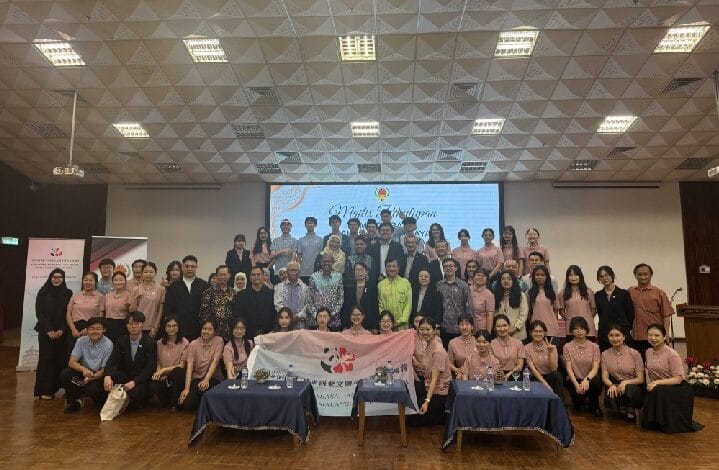
Director of the Centre for Malay Studies at Beijing Foreign Studies University, Su Ying Ying, said closer diplomatic and economic cooperation between Malaysia and China has further boosted student interest in learning Bahasa Melayu.
More than 500 students across 18 Chinese higher education institutions are currently pursuing Malay language studies.
Many students, she said, are attracted not only by educational opportunities but also by Malaysia’s multicultural society, peaceful environment and culinary diversity.
Language Reflects Identity And Values
Rozaimah emphasised that Bahasa Melayu is deeply connected to the values and identity of Nusantara civilisation.
Elements such as politeness, respect and refined communication remain central to the language and continue shaping social interaction among its speakers.
For international learners, studying Bahasa Melayu often becomes a pathway towards understanding Malaysian and regional cultural traditions more deeply.
Observers believe ongoing efforts to internationalise Bahasa Melayu could further strengthen its standing as a respected language of knowledge, diplomacy and culture on the global stage.
-wilayah.com.my